For many agencies and sales teams, the promise of CRM automation remains just that — a promise. Contacts flow in, appointments are booked, and data piles up, but without the right tooling and orchestration, that information never becomes actionable insight.
At THWorks, we recently helped a U.S.–based lead generation agency turn their GoHighLevel (GHL) pipeline into a real-time, scored, and sales-ready intelligence system. This wasn't just another export-and-paste job — it was a custom automation that evaluates lead quality before your team ever picks up the phone.
Here's how we did it, why it worked, and how you can apply the same techniques to your business.
The Challenge: CRM Data Without Insight
Our client relied on GoHighLevel as their central CRM for tracking inbound leads and booked appointments. On the surface, everything looked organized: contacts, calendars, pipeline stages, all neatly inside GHL.
But when it came to execution, the team faced a handful of recurring issues:
- Manual reporting — Every day, someone had to export appointment data and upload it into Google Sheets.
- No lead prioritization — There was no built-in mechanism to score leads by quality.
- Sales inefficiency — Reps often wasted time on low-intent prospects.
- Outdated insights — Even weekly exports were too slow to reflect real sales opportunities.
What the client needed wasn't just automation — it was automation with intelligence. They wanted:
- Automatic capture of booked appointments
- A scoring system to rank the quality of each appointment
- A centralized dashboard to monitor leads in real time
The THWorks Approach: Smart, Scored, and Synced
Rather than building a manual export process, we designed a real-time automation pipeline that did three things:
- Listens to events from GoHighLevel
- Applies a custom lead scoring model
- Updates a live Google Sheets dashboard
This allowed the client's sales teams to see ranked leads in real time, eliminating hours of manual work each week.
How the Automation Works
Here's the logic behind the system:
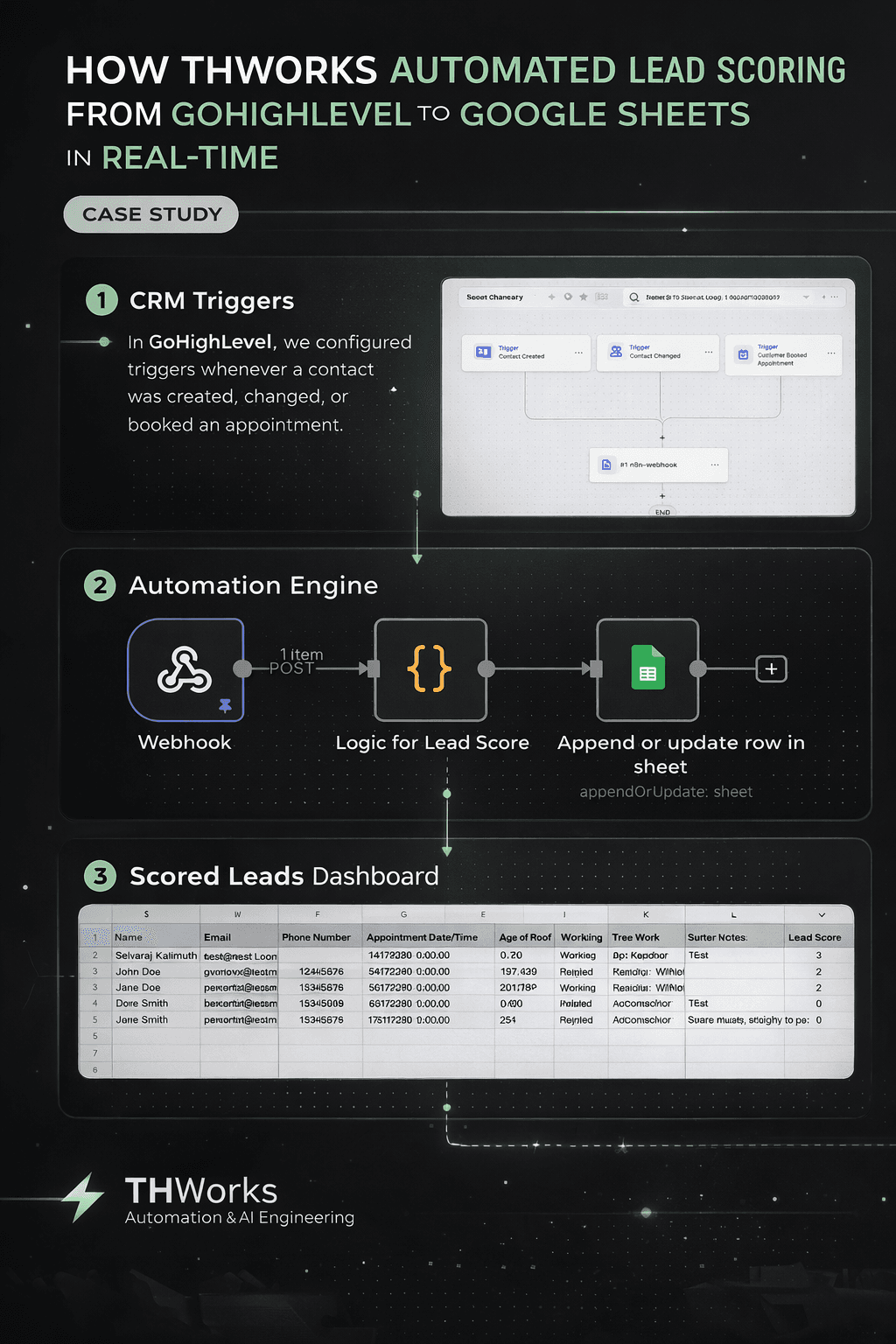
1. Real-Time Triggers via Webhooks
We started by configuring GoHighLevel to emit webhooks when key events occur:
- Contact created
- Contact updated
- Appointment booked
These events are then pushed to n8n, our workflow automation engine of choice.
Unlike time-based syncs (e.g., "every hour"), webhooks allow us to react instantly — meaning as soon as an appointment is scheduled, the data begins moving.
2. Fetching Complete Lead Details
GHL webhook payloads often include only limited information. So once n8n receives the trigger, it calls the GoHighLevel API to fetch:
- Full appointment metadata
- Contact fields
- Custom field values used for scoring
This ensures our logic always works with complete data.
3. Custom Lead Scoring Logic
At this point, we apply a scoring model that reflects the client's business priorities. Each lead is evaluated on specific attributes:
- Age of Roof – This matters when evaluating solar installation prospects.
- Average Utility Bill – Higher bills often signal higher intent.
- Employment Status – Working leads may have different buying behaviors than retired ones.
- Tree Work Requirements – Certain job complexities affect feasibility.
- Other Factors – Fields like buyer persona and keywords help refine the score.
As an example:
A lead with a recent roof, high utility bill, and ready-to-engage profile scores higher than a lead with ambiguous info or disqualifying criteria.
We also normalized the scores so that negative values never make it into the client dashboard. This helps sales teams see meaningful, non-confusing scores instead of arbitrary negatives.
4. Syncing Back to Google Sheets
Once the score is calculated, the enriched lead data is written (or updated) in Google Sheets. This gives the client a familiar interface — easily sortable and shareable — while all data still flows automatically.
No more manual downloads. No more human error. Just live insights.
A Visual Story: From CRM to Scored Dashboard
Here's a quick overview of how the system looks in practice:
📌 GoHighLevel Workflow
Using a combination of triggers inside GHL, we ensured that all important events automatically initiate the scoring pipeline.
🧠 n8n Integration Pipeline
n8n acts as the glue between GHL and Sheets — receiving the webhook, applying scoring logic, and syncing to Sheets.
📊 Google Sheets Live Dashboard
The output is a dynamically scoring dashboard showing real-time lead quality so sales can act fast.
What This Gave the Client
After deploying this automation:
- ✔ Sales reps began their days with prioritized leads
- ✔ The team no longer spent hours on data hygiene
- ✔ Managers gained instant visibility into lead quality
- ✔ Scoring rules could evolve without developer dependency
In short, automation didn't replace the team — it empowered them.
Why This Matters Today
The tools we all rely on — CRMs, calendars, spreadsheets — are powerful on their own. But real competitive advantage comes when those tools talk to each other using smart logic.
Lead scoring is more than a number. When automated at the right time and in the right place, it transforms how teams plan follow-ups, allocate resources, and close deals.
This isn't futuristic — it's practical automation engineered the right way.
Looking Ahead
If your sales stack includes:
- GoHighLevel
- HubSpot
- Salesforce
- Zoho
- Any CRM with webhook capabilities
… and you're struggling with manual reporting, poor prioritization, or stale data, we can help.
At THWorks, we specialize in building systems that transform operational workflow into competitive advantage.
Let's automate the work that steals your time — so your team can focus on closing more deals.
Interested in a custom workflow like this?
Contact us to build your next automation pipeline. 💼🚀