
A multi-broker trading OS with paisa-exact backtest-to-live parity
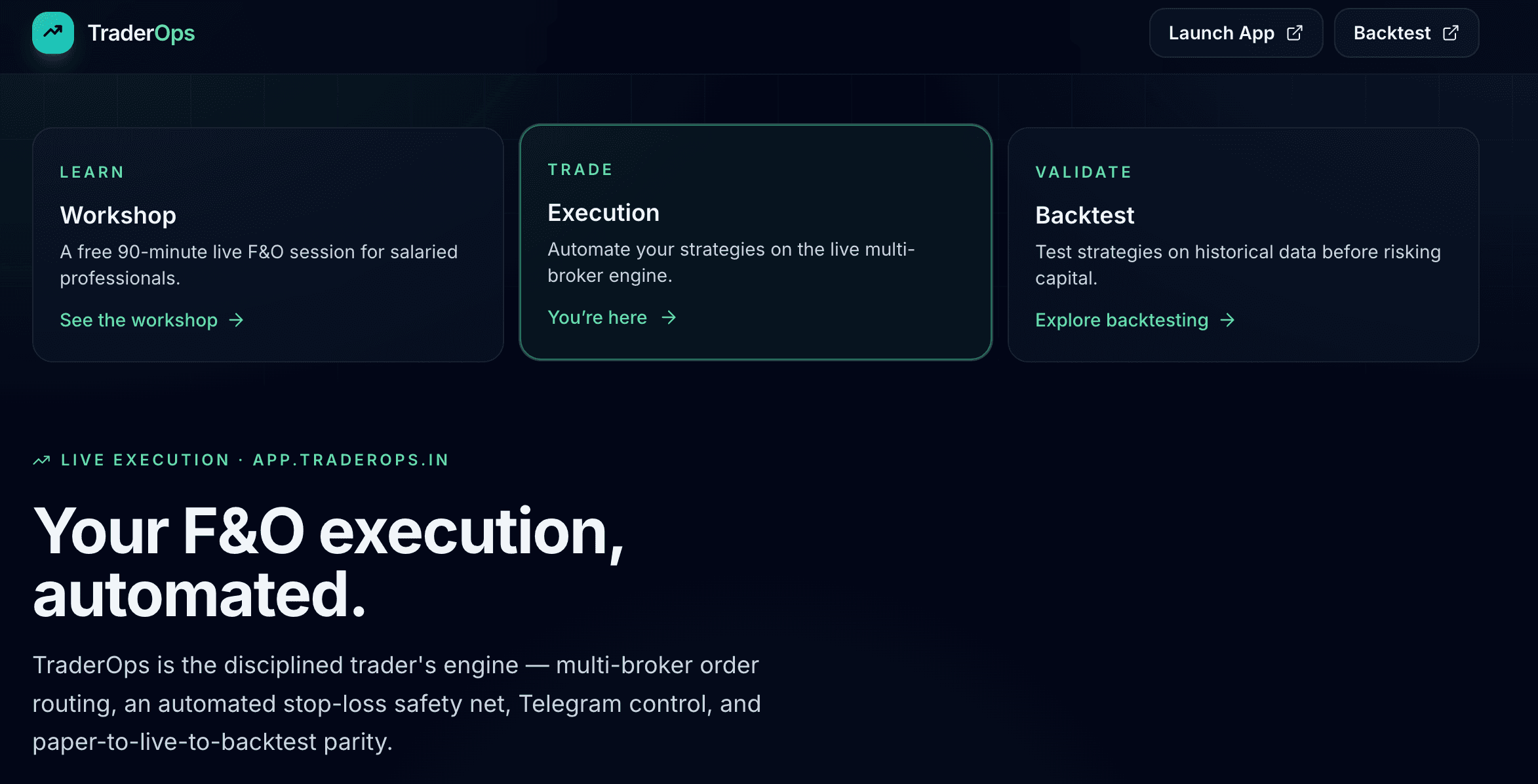
Our own trading engine, built so the strategy you backtest is the strategy that fires. You compose ORB, WAT, re-entry and multi-leg option strategies without writing code, test them against historical data, then run the same strategy live across eight Indian brokers. Trigger prices anchor to the entry you intended rather than the fill you got, so the stop-loss ladder is identical in backtest, paper and live — slippage moves the fill, never the trigger. Kill switches, per-strategy capital limits and a scheduled square-off run underneath, and the engine answers to Telegram and MCP as well as the web.
Our own product, live at app.traderops.in
8
Brokers Supported
Zerodha, AliceBlue, Tradejini, Zebu, Dhan, Delta, Kotak Neo and Motilal Oswal — all Indian, behind one interface
3
Execution Modes
Live, paper and backtest, off the same strategy record
Paisa-exact
Backtest↔Live
Trigger prices anchor to intended entry, so the SL ladder is identical across modes — slippage moves the fill, never the trigger
The client
Our own product, live at app.traderops.in
- Industry
- FinTech & algorithmic trading
- Region
- India
Challenge
Backtests that never survive contact with the live market
Traders run execution in a broker terminal, research in a disconnected backtester whose fills never match reality, and risk management in spreadsheets. Strategies that look profitable in a backtest collapse live because trigger math, slippage, and order-type behaviour differ. Managing stop-losses by hand across multiple broker accounts is error-prone, and there is no safe way to kill everything when a day goes wrong.
Disciplined, salaried traders want trustworthy automation without writing code or babysitting a screen. The goal was one engine where a strategy is authored once and behaves identically in paper and live — so what you test is exactly what you trade — while staying broker-agnostic and safe by construction.

Solution
One engine that does not care which broker is on the other end
TraderOps is a Python/FastAPI engine over PostgreSQL with a broker-abstraction layer that normalises order placement, modification, and reconciliation across every broker. SL/target/trailing trigger prices are anchored to the strategy's intent, so the trigger ladder is bit-exact across live, paper, and backtest by construction — slippage moves the fill, never the trigger.
A single-orderbook reconcile loop is the only path that updates trade state from the broker, removing race conditions between per-order polling and event handling. Market data flows from one shared platform feed rather than per-user tickers, and execution is decoupled from the data source so any broker executes against a common feed. Every action — Telegram command, MCP call, webhook, or scheduler — lands in the same audited trade pipeline.
Calls we would still defend
Paisa-exact parity — trigger prices anchored to expected entry give an identical SL/target/trailing ladder across backtest, paper, and live — the platform's core trust guarantee.
Broker-agnostic capability layer — a frozen per-broker model (tag format, product/exchange maps, order semantics) means engine code never branches on broker name, so adding a broker is additive and safe.
Control anywhere — a read/write MCP server plus a Telegram bot let traders author, fire, and monitor strategies conversationally, behind a two-step confirm gate on every order-placing action.
Safe by construction — mode-scoped kill switches, per-strategy capital limits, and a scheduled MIS auto-square-off protect capital with no manual intervention.
In the product
What it looks like in use
Results
What you test is exactly what you trade
Before
A broker terminal for orders, a mismatched backtester for research, and spreadsheets for risk — with results that never held up live and stop-losses managed by hand across accounts.
After
One engine where a no-code strategy is authored once, validated with paisa-exact parity, and executed live across eight brokers — controlled from Telegram or an AI client, with automated stop-losses and kill-switch safety.
8
Brokers Supported
Zerodha, AliceBlue, Tradejini, Zebu, Dhan, Delta, Kotak Neo and Motilal Oswal — all Indian, behind one interface
3
Execution Modes
Live, paper and backtest, off the same strategy record
Paisa-exact
Backtest↔Live
Trigger prices anchor to intended entry, so the SL ladder is identical across modes — slippage moves the fill, never the trigger
FAQ
The questions this one raises
What was actually built, the constraints it had to meet, and what we would do differently.

SL, target, and trailing trigger prices are anchored to the strategy's intended entry rather than the actual fill, so the trigger ladder is computed identically in backtest, paper, and live. Slippage moves only the fill price — never the trigger — keeping results paisa-exact across modes.
India, today. All eight supported brokers are Indian, and the platform trades what they trade. Korea, Japan, the US, Canada and Brazil are planned, and none of them is live yet — so if you trade outside India, TraderOps is not usable for you at the moment.
Eight right now — Zerodha, AliceBlue, Tradejini, Zebu, Dhan, Delta, Kotak Neo and Motilal Oswal. A broker-agnostic layer normalises how each one behaves, so the same strategy runs on any of them, and adding a new broker doesn’t disturb the ones already live.
Yes. The builder composes ORB, WAT, re-entry, and multi-leg option strategies through configuration — no code — and you can control everything from Telegram or an MCP-connected AI client.
TraderOps ships mode-scoped kill switches, per-strategy capital limits, daily position guards, and a scheduled intraday auto-square-off, so risk controls run automatically rather than depending on manual attention.
You can run identical strategies in paper and live at the same time for a side-by-side comparison, building confidence in a strategy before committing real capital.
Keep reading
Other builds, taken apart the same way
chatbot
A multi-modal assistant with bot defence for a fintech support chat
A financial services platform
nlp
Sentiment analysis that reads the politeness a language builds in
A global retail and e-commerce operator