By Selvaraj, Founder & CEO, ThWorks
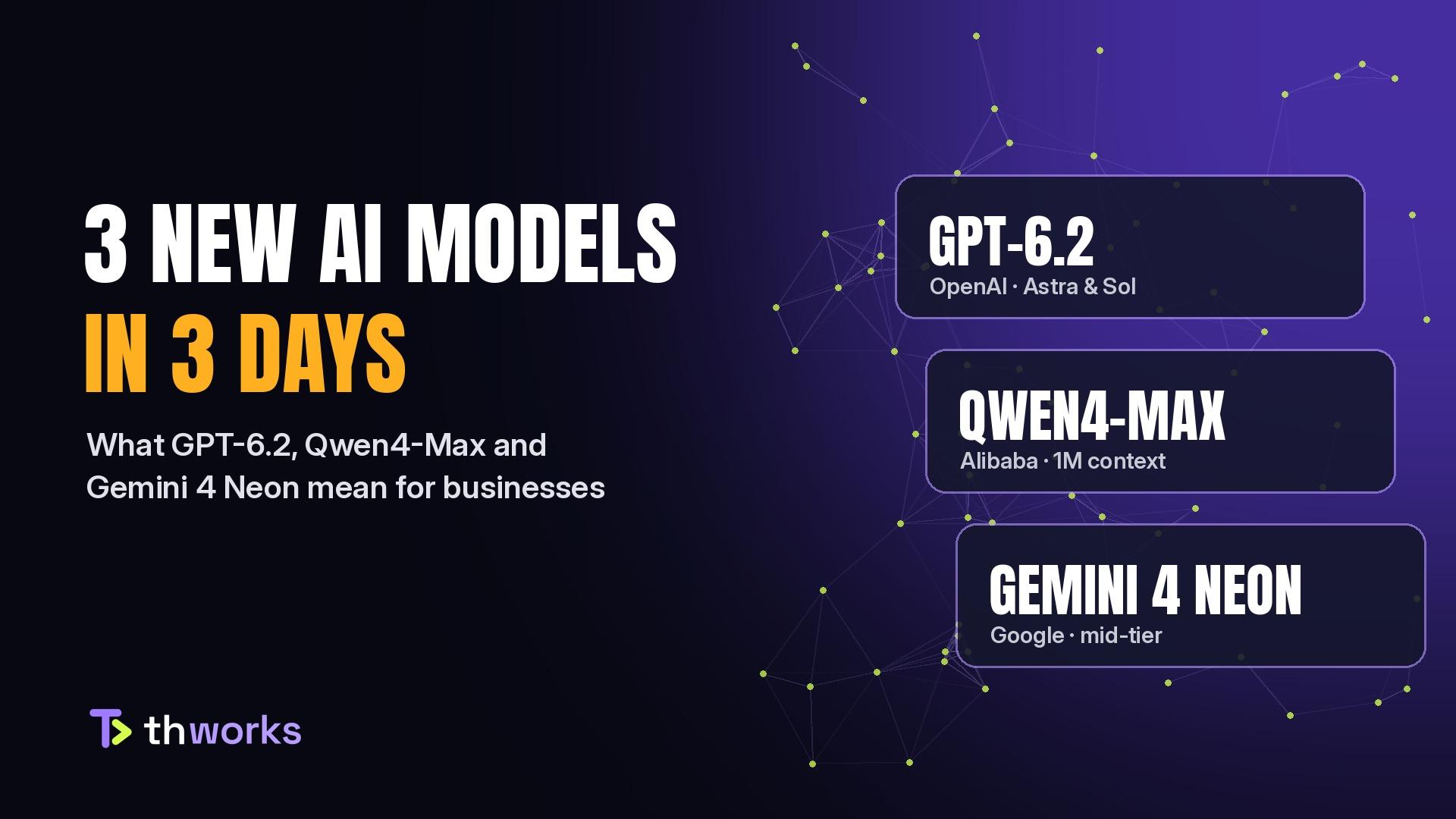
Three of the biggest AI labs released new models within three days of each other in November 2026. Alibaba shipped Qwen4-Max on 16 November, OpenAI shipped GPT-6.2 on 17 November, and Google shipped Gemini 4 Neon on 18 November.
The headlines are about benchmark scores. The more useful story for businesses is cost. Each release offers strong performance at a lower price per task than the model it replaces. That changes which AI projects are worth building.
Here is what each release actually is, and what it means if you run a business that uses, or plans to use, AI.
1. OpenAI GPT-6.2: Astra and Sol
What it is: GPT-6.2 comes as two models. Astra is OpenAI's top model for the hardest professional and scientific work. Sol is a faster, cheaper model built for everyday tasks and multi-step "agent" work, where the AI carries out a sequence of actions rather than answering one question.
What changed: OpenAI says Sol nearly matches Astra on making merge-ready changes to real codebases, at about one-fifth of the cost. Astra sets new highs on OpenAI's professional and research evaluations at less than a third of the previous Astra model's cost per task.
What it costs (API, per 1 million tokens): Astra is $8 for input and $40 for output. Sol is $2 for input and $10 for output.
Where you can use it: In ChatGPT Work and Codex on paid plans, and through the API. Access depends on plan and rollout, so not every account sees it immediately.
What it means: For most business automation (reading documents, drafting replies, running multi-step workflows), Sol is the model to evaluate first. Astra is for the small set of tasks where the hardest reasoning genuinely matters.
2. Alibaba Qwen4-Max
What it is: Alibaba's most capable Qwen model so far. It is a very large model (2.4 trillion parameters) that only uses a fraction of itself for each piece of text (71 billion parameters active per token). This design is called Mixture-of-Experts, and it is one of the main ways labs keep large models affordable to run.
What changed: It can read up to one million tokens at once, roughly the length of several long books, and it understands images natively. On Alibaba's own benchmark across 721 specialised fields, Alibaba reports it uses 35% fewer tokens than the previous version and cuts average cost per task by about 60%. These are Alibaba's figures, not independent tests.
Where you can use it: Through Alibaba's QwenCloud API and its own platforms. Qwen4-Max is not released as open weights, meaning you cannot download and run it yourself. Alibaba says smaller open-weight Qwen4 models are coming "soon".
What it means: Qwen is now a serious option alongside the US labs, particularly for teams that care about price. The open-weight versions, once released, will matter most for businesses that need to run AI on their own servers for data or compliance reasons.
3. Google Gemini 4 Neon
What it is: A new middle model in Google's Gemini 4 family. Google now offers three main models: Hydrogen for everyday help, Neon for deeper analysis, and Carbon for the most complex work. Neon replaces the earlier Argon model in the Gemini app.
What changed: Google positions Neon as close to Carbon on coding, reasoning and agent tasks, at faster speed and lower cost. It reads up to one million tokens and offers four "thinking levels", so you can choose how much reasoning (and cost) each task gets.
What it costs (API, per 1 million tokens): $3 for input and $15 for output. Carbon's promotional price ends on 30 November, after which Neon is 25% cheaper than Carbon.
Where you can use it: In the Gemini app on the AI Pro and AI Ultra plans, and through Google's developer tools.
What it means: Adjustable thinking levels are useful in practice. A business workflow can use low effort for simple steps and high effort only where accuracy matters, instead of paying top price for every step.
4. What this means for businesses
The real trend is price, not just intelligence. All three releases deliver more capability per dollar than what came before. A task that was too expensive to automate last year may now cost a fraction of the time it takes a person to do it.
The middle tier is now good enough for most work. Sol, Neon and Qwen4-Max all target the space between "cheap and simple" and "best and most expensive". For most business automation, that middle tier is where the value is.
Lock-in is a real risk. Models change every few weeks. Prices change too, as the end of Gemini Carbon's promotion shows. Systems built around one provider's model become expensive to move. Systems built so the model can be swapped stay flexible.
Benchmarks are not your workload. Every lab publishes the tests it does well on. The only test that matters is how a model performs on your documents, your customers' questions and your workflows.
A model you can swap is not a weakness. It is a design decision.
What to do now
If you already use AI in your business, this is a good moment to check whether you are paying for a more expensive model than your tasks need.
If you have been waiting because AI felt too expensive or too unreliable, it is worth looking again. Several tasks that did not make financial sense a year ago now do.
The question isn't which model is the best this week. The question is: is your business built so it can use whichever model is best next week?
Talk to us at thworks.org.
ThWorks is a software engineering and AI automation studio. We build automation and custom software that work alongside the systems businesses already run on, working closely with each client's team, remotely.
Sources: OpenAI Developer Community, GPT-6.2 Astra and Sol · AIwire, Alibaba releases Qwen4-Max · 9to5Google, Gemini 4 Neon